My research revolves mainly around understanding and modelling opinions and their dynamics. Over the years, this has taken the form of (1) ResIN and (2) the development of applied opinion dynamics models. Since this process requires measuring opinions, I have also been exploring the concept of measurements and their limitations, leading to focusing on (3) psychometrics and the measurement crisis. My focus on opinions has also brought me to explore how we can design better democratic systems, leading to the study of (4) collective intelligence for democracy.
1. ResIN
ResIN is a (rather new) method for analysing attitudes as a system, almost offering a bird’s-eye view of the attitudes and their relationships. This is done without “forcing” the data with assumptions like linearity, monodimensionality, etc.
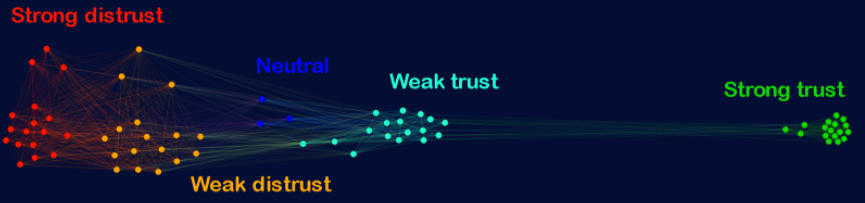
This method produces informative patterns like the one below, where you can already see that the green attitudes are somehow “more compact” and “separated” from the rest.
Besides visual exploration, ResIN offers quantitative information, telling you, for example, the strength of the relationship between two attitudes, the number of attitudes in a group, the level of coherence of a group, etc.
For more information, visit: www.resinmethod.net
RELATED PUBLICATIONS
- Carpentras, D., Lüders, A. & Quayle, M. Mapping the global opinion space to explain anti-vaccine attraction. Sci Rep 12, 6188 (2022). https://doi.org/10.1038/s41598-022-10069-3
- Lueders, A., Carpentras, D., & Quayle, M. . Attitude networks as intergroup realities: Using network-modelling to research attitude-identity relationships in polarized political contexts. British Journal of Social Psychology (2023). https://doi.org/10.1111/bjso.12665
- Carpentras, D., Lueders, A., & Quayle, M. (2024). Response Item Network (ResIN): A network-based approach to explore attitude systems. Humanities and Social Sciences Communications, 11(1), 1-14. https://doi.org/10.1057/s41599-024-03037-x
- Chen, Y., Speer, A., De Bruin, B., Carpentras, D., & Warncke, P. A “broken egg” of US Political Beliefs: Using response-item networks (ResIN) to measure ideological polarization. Network Science, 13, e20. (2025) https://doi.org/10.1017/nws.2025.10016
- Warncke, P., Chen, Y., Speer, A., de Bruin, B., Lüders, A., & Carpentras, D. ResIN: A new method to analyze socio-political attitude systems. In Computational Social Science of Social Cohesion and Polarization (pp. 105-129). Cham: Springer Nature Switzerland. (2026) https://doi.org/10.1007/978-3-032-01373-6_5
2. Applied opinion dynamics
Many social issues depend on people’s opinions (e.g. climate change, vaccination, etc.). Therefore, it would be extremely useful to have models that allow us to understand how people form, exchange and update their opinions. Furthermore, these models could be used to design more efficient and safe communication campaigns and interaction systems. For example, one could design a social media platform that, instead of fostering hatred and polarization, could foster meaningful dialogue, and sense of shared understanding.
Unfortunately, while there is a massive literature on opinions, our understanding of how they form and update is still very rudimentary and definitely not ready for applied models.
Given the complexity of this task, I try to approach it from different angles:
- Develop models that closely mimick experimental or empirical dynamical data at the micro-level (i.e. agents that reproduce the behavior of individual participants)
- Develop models that can better reproduce complex macroscopic patterns that we observe in empirical data
- Develop models that can better integrate the properties of real opinion data (such as ordinality).
- Develop techniques for testing and validating opinion dynamics models.
RELATED PUBLICATIONS
- Carpentras, D., & Quayle, M. (2025). Distorted claims about distortions: A response to Reflections on the house of mirrors. International Journal of Social Research Methodology, 1–7.
- Carpentras, D., Maher, P. J., O’Reilly, C., & Quayle, M. (2023). How polarization extends to new topics: An agent-based model derived from experimental data. Journal of Artificial Societies and Social Simulation.
- Carpentras, D., & Quayle, M. (2023). The psychometric house-of-mirrors: The effect of measurement distortions on agent-based models’ predictions. International Journal of Social Research Methodology, 26(2), 215–231.
- Carpentras, D., Maher, P. J., O’Reilly, C., & Quayle, M. (2022). Deriving an opinion dynamics model from experimental data. Journal of Artificial Societies and Social Simulation, 25(4).
- Carpentras, D., & Quayle, M. (2022). Propagation of measurement error in opinion dynamics models: The case of the Deffuant model. Physica A: Statistical Mechanics and its Applications, 606, 127993.

3. Psychometrics and measurement crisis
One of the main problems of measuring abstract constructs (such as opinions) is that they are usually defined as vague concepts. This means that there are possibly infinite different ways to measure them. While the common assumption is that this should not really be a problem (i.e. as long as you are measuring the right construct, you should obtain the right result), there are many evidences that this is not true. Indeed, two equally valid operationalizations of the same construct or test may produce completely opposite results.
Unfortunately, this domain is still largely unexplored. We will need more studies to understand how big or small such a problem is.
RELATED PUBLICATIONS
- Carpentras, D. (2024). We urgently need a culture of multi-operationalization in psychological research. Communications Psychology, 2(1), 32.
- Carpentras, D., & Warncke, P. (2024). The hidden problem in big data: Even infinite information does not guarantee consistent measurement. Society Register.
- Carpentras, D., & Quayle, M. (2023). The psychometric house-of-mirrors: The effect of measurement distortions on agent-based models’ predictions. International Journal of Social Research Methodology, 26(2), 215–231.

4. Collective intelligence for democracy
From the literature on collective intelligence (and collective stupidity), we know that people sometimes can coordinate and achieve outstanding goals to the point where multiple non-experts can outperform experts on a task. Other times, instead, a group can be so dysfunctional to be easily outperformed by a person working in isolation. Why is that?
The solution to this mystery seems to lie in the system: if the system is structured so that people’s skills and goals can align, then collective intelligence can arise. If, on the contrary, the system is structured to produce a clash of goals and skills, we will likely observe collective stupidity.
Unfortunately, democratic systems need to produce solutions to public problems in a context where people can have very different goals, skills and opinions. Because of that, they tend to “keep people out” of the system, consulting them only on very specific occasions, like for elections.
In my work, I explore methods in which we can integrate citizens more into the problem-solving and decision-making of democracy.
RELATED PUBLICATIONS
- Carpentras, D., Hänggli Fricker, R., & Helbing, D. (2024). Empowering minorities and everyone in participatory budgeting: an agent-based modelling perspective. Philosophical Transactions A, 382(2285), 20240090.
- Carpentras, D., Dailisan, D., Carissimo, C., Nebiker, S., & Helbing, D. The Wisdom of the Democratic Crowd: Allowing Collective Intelligence at Massive Scale. Preprint. 10.13140/RG.2.2.11190.77127